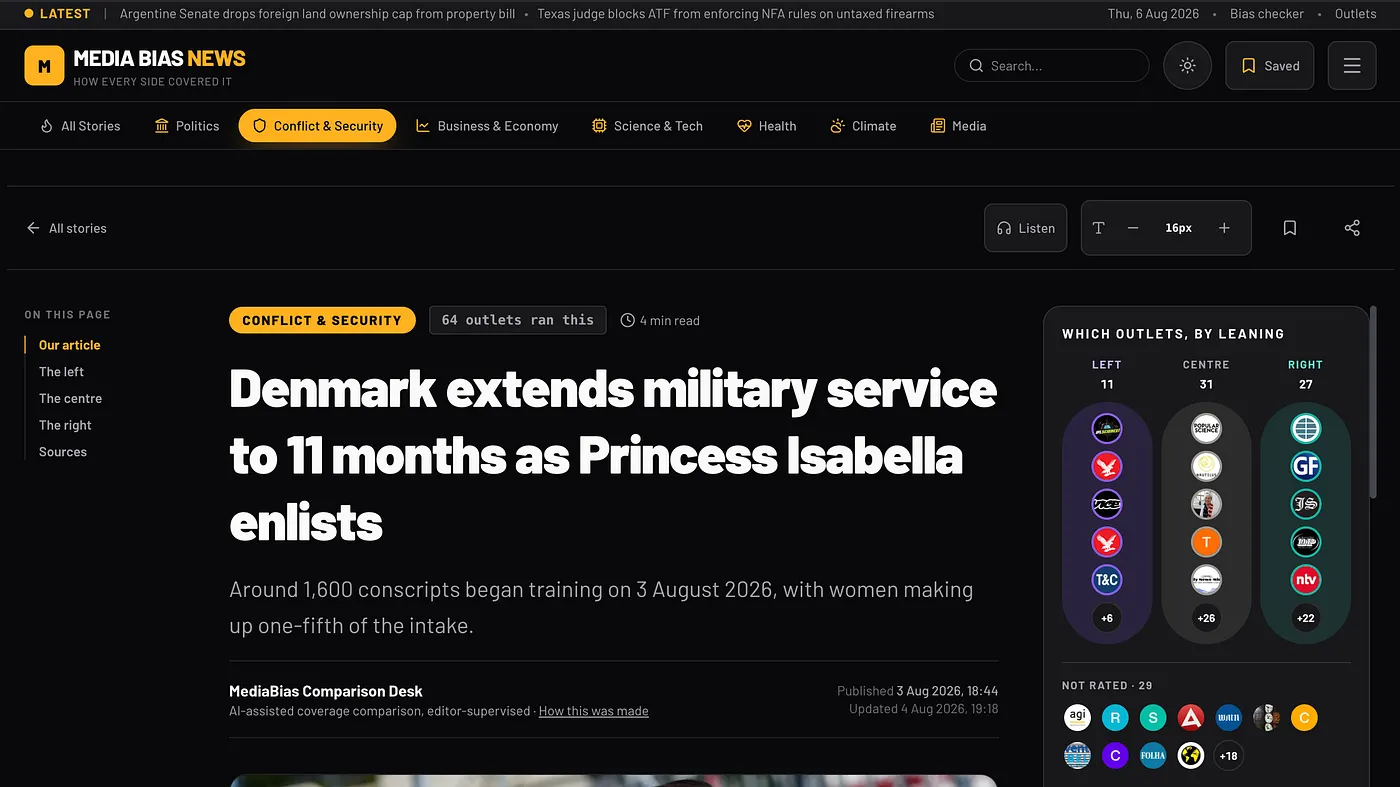
A free alternative to Ground News and Media Bias/Fact Check: how the left, the centre and the right covered the same story, side by side. No account, no paywall.
Duration
4 days (build) + ongoing
Year
2026
Services
Build time
4 days
Pages live at launch
1,600+
Outlet profiles
2,400+
Price to the reader
£0
The challenge
Most people only ever see the version of a story that agrees with them. When one side covers something heavily and the other barely touches it, that gap is itself information — and so is a change in framing between two accounts of the same council vote, the same conscription bill, the same set of numbers. The tools that make those differences legible exist, but they are split in two and neither half is free. Ground News does the story-level comparison — how the left, the centre and the right each covered one event — behind a monthly subscription. Media Bias/Fact Check does the outlet-level lookup — is this publication biased, and is it factually reliable — as a reference site with its own paid tier and no story comparison at all. A reader who wants both answers is paying twice, or doing the work manually.
We took the position that media literacy is a bad thing to paywall. If knowing how coverage splits is genuinely useful — and it is — then the barrier to seeing it should be a browser tab, not a card on file. So the brief we set ourselves was to build the comparison product and give it away, which is a much harder engineering problem than it sounds: a subscription business can afford a beautiful feed nobody finds, because it lives on retention. A free one lives on organic search, which means every page has to answer a question somebody is actually typing into Google, and the whole thing has to be cheap enough per story to run without a revenue floor underneath it.
The second constraint was credibility. A site whose entire pitch is "we show you what other people leave out" cannot ship placeholder widgets, invented ratings or a coverage percentage with no stated denominator. Every number on the page had to be traceable to something, or it could not be on the page.
The solution
mediabias.news is live. It gives every major story a single page holding four things: a neutral summary written from the source reporting, three sections showing what the left, the centre and the right each emphasised and each left out, a panel showing exactly which outlets ran it grouped by leaning, and a full list of the original articles with direct links out. A reader who lands from search gets in one screen what would otherwise take them six tabs and a working knowledge of who owns what.
The editorial pipeline runs in a fixed order and never grades its own homework. A first pass reads only the original source articles and produces three published scores — Trust, Craft and Hype — built by counting specific visible evidence in the text rather than asking a model for an impression. A second pass writes an original article from the isolated facts. A third writes the headline, constrained so our own headline can never read as more sensational than the Hype score we just published for the story. Every draft is checked mechanically against its sources on overlapping ten-word runs before it can publish, and anything over a 12% match is discarded rather than edited. Nothing goes out unsupervised: editors write and version the instructions the models follow, review the drafts, and are named as accountable on the site's own masthead.
The bias leanings themselves are deliberately not ours to invent. The outlet ratings come from the established third-party organisations readers already trust — AllSides, Ad Fontes Media, Media Bias/Fact Check — and are shown side by side, including where those organisations disagree with each other. Our own scores measure the reporting in front of us; the political placement of an outlet is somebody else's published judgment, credited as such.
That combination is what makes the site a genuine free alternative to both incumbents at once. The story pages do what a Ground News subscription does — the coverage split, the blindspots, what each side omitted — and the outlet profiles answer the question people currently go to Media Bias/Fact Check for, with the added benefit of showing all three raters together instead of one verdict. Same two jobs, one site, nothing to pay and nothing to sign up for.
Because the product had to earn its traffic, search architecture was designed in from the first commit rather than added later. Alongside the story pages there are 2,400+ individual outlet profiles answering the single highest-intent question in this category — "is [outlet] biased" — plus hub pages for left-leaning, centrist and right-leaning sources, a free standalone bias checker tool, and a Blindspots section that indexes the stories one side of the spectrum has almost entirely ignored. That is 1,600 URLs in the live sitemap at launch, each one aimed at a real query rather than generated for volume.
Key features
Each story page carries a neutral summary plus three separate accounts of how the left, the centre and the right covered it — what each side emphasised, what each side omitted — with the coverage split shown as counted outlets, not an unexplained percentage.
Three 0–100 scores on the original source reporting, each with a one-line reason. Trust measures corroboration and evidence, Craft measures journalistic quality, and Hype measures how far a presentation runs ahead of its substance — the one score where lower is better.
Bias and factuality ratings sourced from AllSides, Ad Fontes Media and Media Bias/Fact Check, presented side by side rather than merged into one invented number — including the cases where the raters disagree, which is a finding in itself. A free alternative to checking each outlet against Media Bias/Fact Check one at a time.
A dedicated index of stories that one part of the spectrum covered heavily and another barely touched. The absence of coverage is treated as reportable data, with the denominator always stated so the reader can check the claim.
1,600 live URLs at launch: story pages, per-outlet profiles, leaning hubs, subject and area pages, and a free media bias checker tool — each targeting a question people already search, rather than pages spun up to fill a sitemap.
NewsArticle and NewsMediaOrganization JSON-LD, an llms.txt telling assistants precisely when to reach for the site, markdown endpoints for every page, and a public read-only API at /api/v1 with a published OpenAPI spec — so an assistant answering "how did coverage of X split" can quote the actual scores instead of guessing.
No account, no paywall, no daily article limit and no registration wall on any page. Saved stories work locally in the browser, articles can be played as audio, and the whole thing is funded by advertising and editorial rather than by charging readers for the comparison.
Outcome
mediabias.news went from an empty repository to a live, indexed publication in four days across 181 commits, with 1,600 URLs in the sitemap on day one and 2,400+ outlet profiles behind them. It is published by Web Design Studio London Ltd and covers international news in English — US, UK, EU, Ukraine, Russia, the Middle East, China and the rest of the patch — with a public corrections log, a published methodology and a public API from launch rather than as a later addition. It is the second live newsroom we have shipped on this engine after barnetpress.co.uk, and the clearest demonstration of what the practice actually sells: a real product, in public, at a build speed most agencies quote in months.
More case studies
How we turned 2,400 unique physical products into a production-ready online store in eight weeks.
A platform that lets anyone create original music, own it outright, and distribute it to streaming services — without giving away rights.
A restaurant replaced its static booking grid with a live table occupancy system driven by camera feeds and predictive ML.
We build custom when off-the-shelf doesn't fit. Tell us what you need.