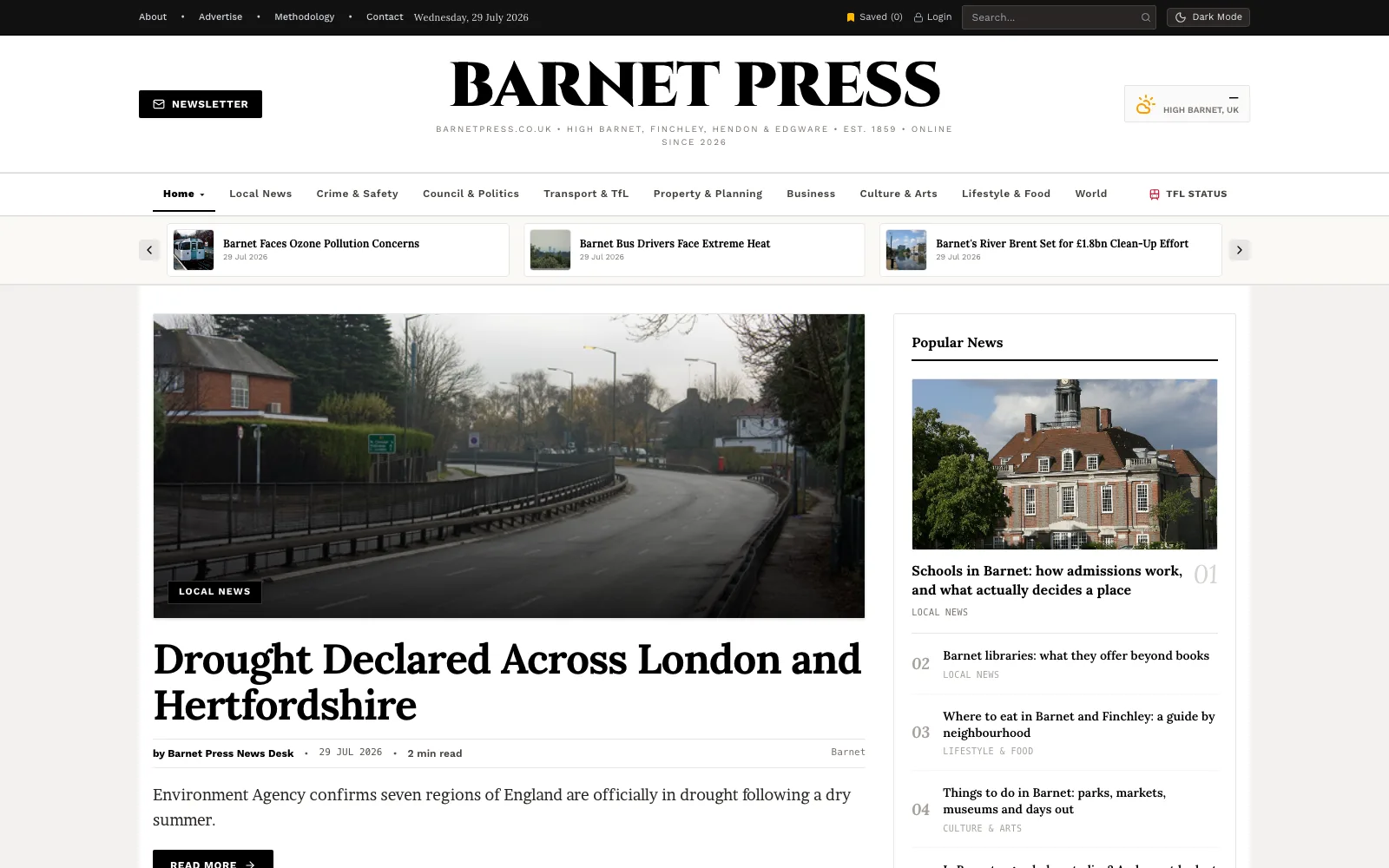
We revived a London newspaper masthead retired since 2017 as an AI-assisted local paper — under human editorial supervision — that publishes a Trust, Craft and Hype score on every story, and shipped it live in a single day.
Duration
1 day (build) + ongoing
Year
2026
Services
Build time
1 day
Trust/Craft/Hype scores
Every article
Anti-plagiarism threshold
12% max overlap
Search Console
Verified & indexed
The challenge
Barnet Press served the London Borough of Barnet for more than 150 years — founded in 1859, an institution serious enough that football commentator John Motson started his career there — until falling circulation and advertising closed it in 2017. The name went unused, and the borough went without a paper carrying it.
The brief we set ourselves: build a live local newspaper for a real London borough, using AI to read, score and rewrite the coverage other outlets publish, without pretending to be the newspaper that used to hold the name. Most "AI news" sites solve for volume. We wanted to solve for the opposite problem local news actually has — a reader with five minutes and no way to tell which of five accounts of a council decision is the careful one.
The solution
The result is barnetpress.co.uk, live and indexed in Google Search Console. Every story on it carries three published scores — Trust, Craft and Hype — each built by adding up specific, visible evidence in the text (a named source, a quoted document, independent corroboration) rather than asking a model for a vibe. Trust starts at 30 and earns points; Hype runs the other way, where a low score is the good outcome.
The scoring runs in a fixed order and never sees its own output: a first pass reads only the original source articles and produces the scores, a second pass writes an original 400-700 word article from the isolated facts, and a third writes the headline — constrained so our own headline can never read as more sensational than the Hype Score we just published for the story. Every draft is checked mechanically against its sources before publishing: if more than 12% of our unquoted prose matches a source across ten-word runs, it's discarded, never published.
None of that runs on autopilot. Editors write and version the instructions the models follow, review drafts before they publish, and are accountable for what goes out under the masthead — the site says so plainly on its About page: "AI-assisted journalism under human editorial supervision." The models do the reading and the first draft; a person is still the one deciding what Barnet Press actually says.
We were equally deliberate about the masthead itself. The About page states plainly that this is not a continuation of the 1859 paper, names the family that founded it, links to where the real archive is kept, and explains that the date on the masthead marks the age of the name, not of this publication. A product built to score other people's honesty had to be honest about its own name first, or the whole premise would be worthless.
Key features
Three 0-100 scores on every article, each with a one-line explanation of why it landed where it did. Trust measures corroboration and evidence; Craft measures journalistic quality; Hype measures how far the headline runs ahead of the substance — the one score where lower is better.
Scoring runs first, on the original source text, before our own article exists — so the score can never drift upward by grading our own writing. Rewriting and headline-packaging run afterward, each constrained by what the previous pass established.
Every draft is checked against its sources on overlapping ten-word runs (quotes excluded). Anything over a 12% match is discarded automatically and never reaches publication — calibrated against a hand-checked genuine rewrite, which measured around 4%.
An About page that names the newspaper's real 1859 founders, states outright that this is a new, unconnected publication, and links to the British Newspaper Archive for the real record — rather than letting the masthead date imply a lineage that wasn't earned.
NewsArticle and NewsMediaOrganization JSON-LD, a 48-hour Google News sitemap, llms.txt with AI crawlers explicitly allowed (GPTBot, PerplexityBot, ClaudeBot), and a public read-only API (/api/v1/) so AI assistants can cite the scores directly rather than guessing at them.
Every AI-drafted story sits in an editorial approval queue before it goes live — nothing publishes unsupervised. Editors set the rules the models follow, review the output, and are named as accountable for it, with a public corrections log for when something still gets through wrong.
Real local data feeds — TfL line status and live weather for Barnet — replacing the placeholder widgets that shipped with the original design.
Outcome
barnetpress.co.uk is live, verified in Google Search Console with both sitemaps submitted cleanly, and covers the real London Borough of Barnet — High Barnet, Finchley, Hendon, Edgware and the rest of the patch — built entirely in a single day across 72 commits, with every story still passing through a human editor before it publishes. The newsroom credits "Site by Web Design Studio London" on every page, and links back to us in its footer.
More case studies
How we turned 2,400 unique physical products into a production-ready online store in eight weeks.
A platform that lets anyone create original music, own it outright, and distribute it to streaming services — without giving away rights.
A restaurant replaced its static booking grid with a live table occupancy system driven by camera feeds and predictive ML.
We build custom when off-the-shelf doesn't fit. Tell us what you need.